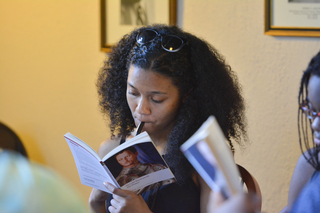
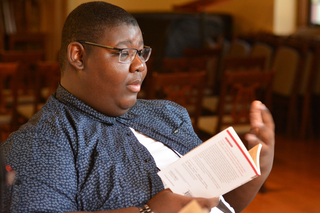
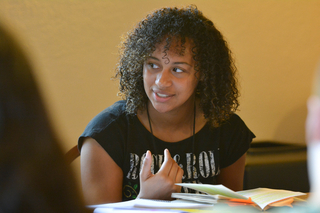
Since 2016, the Citizens Thinkers Writers program has been bringing local public high schoolers into college-style seminars on transformative texts from the history of political thought and linking those texts to live political questions. They meet leaders active in the city’s government and civil society to explore the practical implications of their discussions, to learn how power works in the city, and to reimagine what they might do together as citizens. Mentored by faculty, graduate students, and undergraduates, the high school students learn to translate their civic thinking into effective writing and speaking, key skills of citizenship, while the mentors develop a sense of responsibility for knowing and passing on civic knowledge and competencies.



“He came home talking of Hobbes, and New Haven politics, and of hopes to study the classics in college. He told me that he made friends with kids from 7 different New Haven city schools. He seemed to be glowing with excitement about the future. I feel like this has been a life changing experience for him and the friends that he made too.”
Parent of Citizens Thinkers Writers ’24-25 student



About the Program
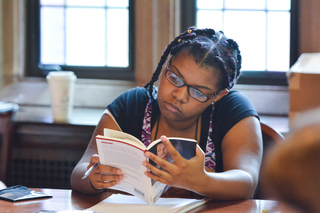
Citizens Thinkers Writers is a tuition-free two-week summer residential program and year-long fellowship program at Yale University for students from New Haven public schools who are interested in exploring fundamental human questions in a college setting. In small discussion seminars led by professors, students will gain invaluable experience in close reading, analytic writing, and college-level discussion. They will see themselves as active participants in a long-running philosophical conversation that dates back to ancient Greece and Rome, and will link this conversation to their own experiences as citizens of twenty-first-century New Haven.
- Experience life on a college campus
- Join a small community of intellectually ambitious students
- Explore great books and the questions they raise
- Receive mentorship and support in the fall with the college application process from Yale undergraduates
- Learn from local field trips and guest speakers
- Eligible participants will receive a $500 stipend
Most Recent Syllabus
During the summer intensive we read reflections on civic life by philosophers, historians, poets and social theorists writing at different times and in different social circumstances. We read ethical advice from aristocrats and from formerly enslaved persons, from the wealthy and from authors born into poverty, from individuals holding power and from individuals suffering persecution. We will read different genres of writing, from philosophical dialogues and tragic plays to social theory and poetry, with a good dose of public oratory too.
Our theme is “citizenship and the city”: What important questions arise when human beings live together in cities? How have thinkers asked and answered these questions in different times and places? What can we find in these works that might help us understand our own roles and responsibilities today? How could we change our city for the better?
Monday: Cities and Human Flourishing
How does the design of a city influence the lives of its citizens? How might living in a city improve our chances to live full and happy lives? What special challenges come with living together in cities? What does it mean to be a citizen of a particular city or country?
- Charles Montgomery, Happy City: Transforming our Lives through Urban Design, selections
- Aristotle, Politics, selections on citizenship from book 3
Tuesday: The Common Good and Freedom
Today we compare two ancient Greek cities, Sparta and Athens. Sparta was famous for the discipline and public-spirit of its citizens, while Athens viewed itself as a standard-bearer for freedom. Consider how the Spartan emphasis on the common good that appears in Plutarch’s description differs from the Athenian emphasis on freedom in Pericles’s speech to the Athenians. How did the Spartans produce public-spiritedness in their children? Was the Spartan educational system compatible with freedom? What were the strengths and weaknesses of the Athenian way of life? Which city would you rather live in?
- Thucydides, Pericles’s “Funeral Oration” in History of the Peloponnesian War
- Plutarch, “Life of Lycurgus” in Greek Lives, selections
Wednesday: Questioning the City’s Norms
Socrates, the most famous philosopher of ancient Greece, was brought to trial as an old man on charges of failing to believe in the city’s gods and of corrupting the youth. Plato offers us a version of the speech Socrates gave in his own defense at his trial – where he was sentenced to death for his crimes. Why did the Athenian jury convict Socrates? Can asking philosophical questions in the way that Socrates did really be dangerous to the city? Why or why not?
- Plato, The Apology of Socrates
* Writing Workshop
Thursday: Law and Justice (I)
If you were in jail on death row for violating a law that you knew to be unjust, and a friend offered to sneak you out – would you escape? Socrates refused to escape in that situation. Why?
Thousands of years later, Martin Luther King, Jr. wrote a famous letter from jail arguing that it was acceptable to break the law of the land if that law was unjust and if one was ready to accept the punishment. King referred to Socrates three times in that letter. How was his position similar to Socrates’s, and how was it different?
- Plato, Crito
- Martin Luther King, Jr., “Letter from a Birmingham Jail”
Friday: Law and Justice (II)
Sophocles’s great tragic play explores what happens when a young woman insists on burying her brother’s body, even after the king and law of the land forbid her to do so. Antigone claims she is obeying a higher law. Does she act justly? What would you have done in her place?
- Sophocles, Antigone
* Public Speaking & Civil Discourse Workshop
Monday: Politics, Morality, and Human Nature
Hobbes thought that when trying to persuade citizens to accept and obey a government, “the passion to be reckoned upon is fear.” In this famous chapter on the natural state of mankind, he described what life would be like without an effective state power or “sovereign.” What was his understanding of human nature and how did it influence his understanding of politics?
- William Shakespeare, Julius Caesar, selections
- Thomas Hobbes, Leviathan, chapter 13, “On the natural condition of mankind”
* College Search Workshop
Tuesday: Consent, Freedom and Equality
How can it be just for free individuals to come under the authority of a government? Locke famously proposed a standard of consent. His argument was then invoked by the authors of the Declaration of Independence. What assumptions about human nature and about political life lie beneath this argument? Have you consented to be governed by the government of the United States today?
- John Locke, Second Treatise of Government, selections
- The Declaration of Independence
Wednesday: The Legacy of the Declaration
The Declaration’s demand that governments respect individual rights did not apply to everyone at first. As a corrective, in 1848 for the Women’s Rights Convention, Elizabeth Cady Stanton penned, “We hold these truths to be self-evident, that all men and women are created equal…” What is the impact of these words on a reader today? Frederick Douglass’s Independence Day speech illuminates both the hypocrisy and promise of the ideas professed in America’s founding documents. How does Douglass use rhetoric to make his critique?
With a much shorter speech, Abraham Lincoln made the Declaration the centerpiece of the American experiment. Why do you think he emphasized the Declaration instead of the Constitution?
- Elizabeth Cady Stanton, “Declaration of Sentiments”
- Frederick Douglass, “What to the Slave is the 4th of July?”
- Abraham Lincoln, “The Gettysburg Address”
Thursday: Self-governance, Exclusion, and Education
What kind of education do democratic citizens require? Is there a difference between education and schooling? Should there be qualifications for self-governance, or is it a basic right? W.E.B. Du Bois, Audre Lorde, and James Baldwin offer differing perspectives on the role of education in an unjust and unequal society. These thinkers challenge us to consider the purpose and meaning of education.
- W.E.B. Du Bois, Souls of Black Folk, selections
- James Baldwin, “A Talk to Teachers”
- Audre Lorde, “Poet as Teacher—Human as Poet—Teacher as Human”, “Poetry Makes Something Happen”
Friday: Democracy and City Life
How can words best capture the promise and the challenges of city life? How does Thoreau’s mocking of gossipy social life compare with Whitman’s reverential treatment of diversity and possibility? What truths does Brooks capture that the others miss?
Is a happy, moral city really possible or even desirable? In her short story, Le Guin challenges readers to imagine the perfect city and consider the role that suffering plays in politics and art.
- Henry David Thoreau, Walden, “The Village”
- Walt Whitman, “Broadway,” “Democratic Vistas,” and “Mannahatta”
- Gwendolyn Brooks, “Kitchenette Building”
- Ursula K. Le Guin, “The Ones Who Walk Away from Omelas”
Who should apply?
- Current sophomores and juniors who love to read and discuss big questions
- Curious, engaged, and committed students from a range of academic ability levels and interests
- Aspiring college students who attend public school in New Haven
- Preference to students who would be first in their immediate families to attend college
- No minimum GPA or prior experience with philosophical texts required
When does the program run?
- Program dates are June 28-July 10, 2026
- Students live on campus Sunday evening through Friday and go home for the weekend
- Students become part of the CTW Fellowship Program and meet regularly from September 2026 – May 2027
